Meta isn't harder now. It's different. The algorithm does more of the buying, so what decides your results moved: from settings and audiences to creative, offer, and the data you feed back. Here's what actually moves the needle, in plain words.
Real estate, healthcare, education, D2C and B2B tech. Different industries, the same 11 questions.
I've run Meta for developers, hospitals, coaching brands, D2C labels and B2B tech companies. The same pattern shows up everywhere: the account looks fine in Ads Manager, and the business still isn't growing. These are the 11 questions founders ask me most, answered the way I'd answer them across the table.
01Efficiency
Our cost per lead keeps rising. Is Meta just getting expensive?
Partly. But in most accounts the real cost is waste, not price.
When I open an account, the money usually leaks in three places: too many small campaigns splitting the budget so none of them learns, ads judged on cheap clicks instead of real enquiries, and audiences overlapping so you bid against yourself. Fix those and the "Meta got expensive" story often goes away.
In practice
Fewer campaigns, more budget each, and one clear conversion goal per campaign. Then judge the account on cost per qualified lead, not cost per lead.
02Creative
What matters most on Meta now?
The creative. It's become your targeting.
Meta now decides who sees your ad largely by what the ad says and shows. A hospital ad about "the night before surgery" finds anxious families. A generic "best hospital in Gurugram" ad finds everyone, and converts no one. Your creative is the brief you give the algorithm.
Test different ideas, not 40 colour variations of one idea.
Write for one specific person and moment.
Use AI to produce more variations fast, and keep the judgment on which idea is worth scaling.
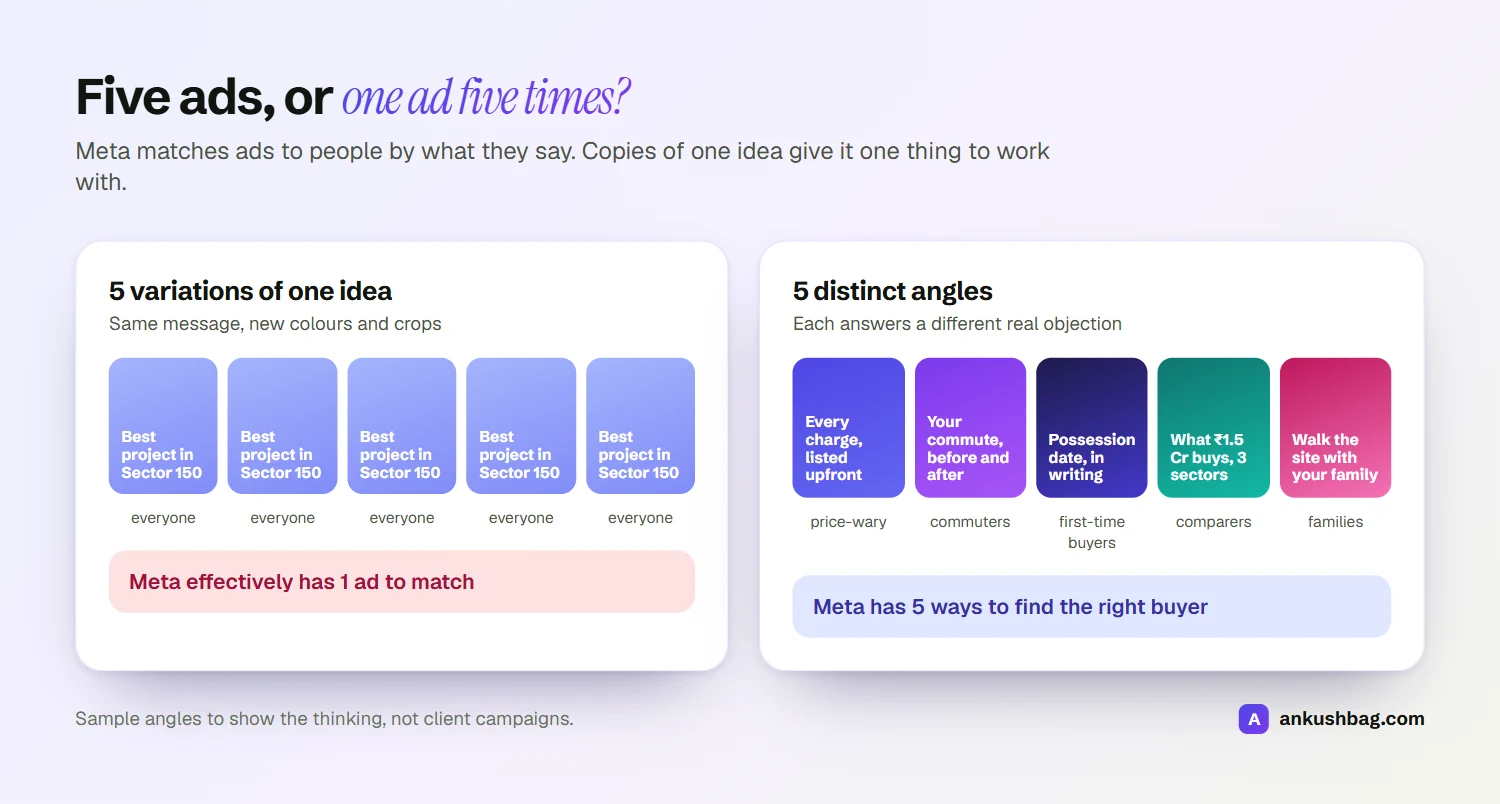
Copies of one idea give Meta one ad to match. Distinct angles give it five ways to find the right buyer.03Targeting
Should we still build detailed interest audiences?
Mostly no. Broad usually wins, if your creative and data are good.
Stacking interests feels like control, but it usually just shrinks the pool and raises costs. Broad targeting lets Meta find buyers using signals you can't see. The catch: broad only works when the algorithm is learning from good outcomes. Feed it junk conversions and broad finds you more junk, very efficiently.
Real estate example
A ₹4 crore project and a ₹60 lakh project shouldn't be optimised on the same "lead" signal. The creative, the offer and the conversion you send back are what tell Meta which buyer you want.
04Research
We keep testing ads. Why do most of them flop?
Because the testing starts before the research does.
Most failed ads aren't badly made. They answer a question the customer isn't asking. Before a single ad, I want to know the real objection: for a coaching brand it might be "I don't have time", for a hospital "what will it cost", for a developer "will the possession date slip". Sales calls, reviews and comment sections tell you this for free.
Listen to 10 sales or presales calls before writing ads.
Turn the top 3 objections into 3 ad angles.
Let results tell you which objection really matters.
05Tracking
Can we trust what Meta's dashboard tells us?
Trust it for direction. Never for revenue.
Meta reports what Meta can see: clicks, form fills, pixel events. It can't see what your sales team did with the lead, and it tends to give itself credit generously. The number you can trust lives in your CRM: how many leads were reached, qualified and closed, by campaign.
The fix I set up most often
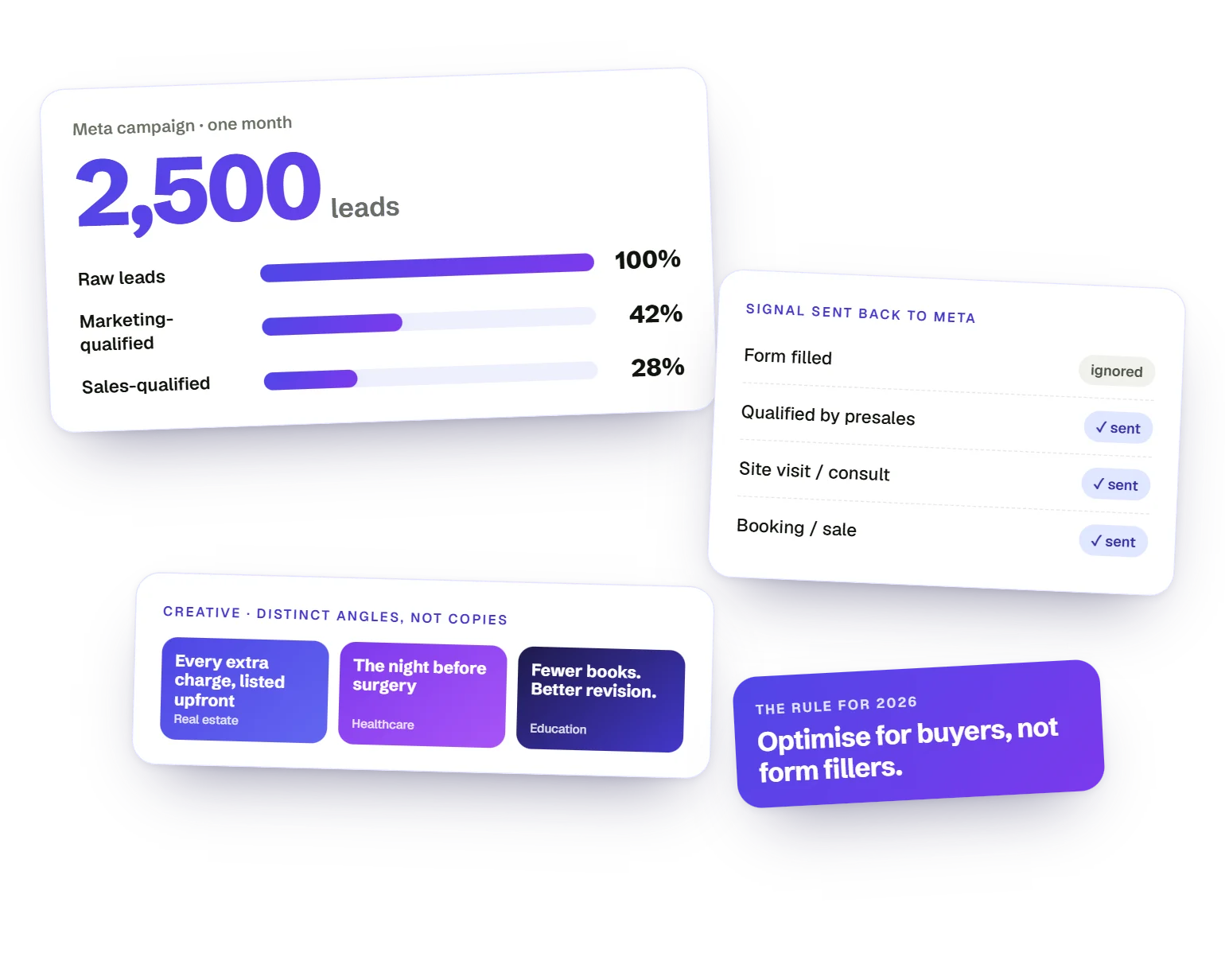
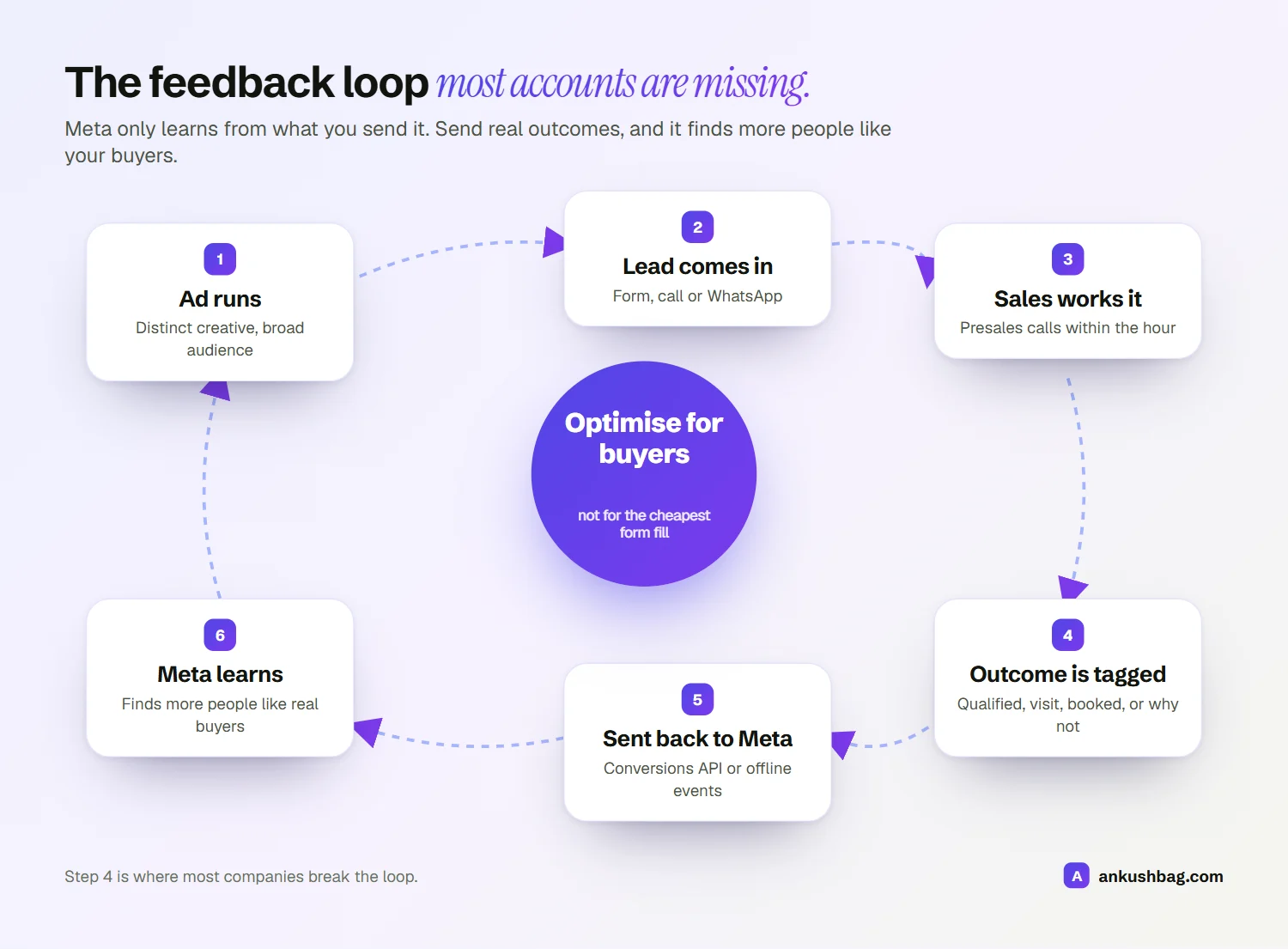
Send real outcomes back to Meta (qualified lead, site visit, booked consultation, admission, purchase) through the Conversions API or offline events. Then the platform optimises toward buyers, not form fillers.
Step 4 is where most companies break the loop. Without it, Meta keeps learning from form fills.
Meta got much better at matching ads to people, so variety in your creative matters more than ever.
Andromeda is the system Meta uses to pick which ads to show each person, and it can weigh far more ads at once than before. In plain words: if you give it five ads that all say the same thing, it effectively has one ad to work with. Give it genuinely different angles, and it can match each one to the people it fits best.
That's why accounts running one "hero" ad for months often stall now, while accounts with a steady flow of distinct creative keep scaling.
07The offer
Can better ads fix a weak offer?
No. You can't out-spend a weak offer.
If the offer isn't compelling, every rupee of extra budget just shows a weak offer to more people. The offer isn't only price. It's what someone gets, how fast, and how little risk they take.
Real estate: a site visit with transport, or all charges listed upfront.
Healthcare: a clear first-consultation price and what's included.
Education: a free demo class or counselling session.
D2C: a starter kit instead of a discount.
B2B: a short audit, not "book a demo".
08The hook
How much does the first few seconds of an ad matter?
Almost everything. If the first 3 seconds don't stop the scroll, nothing after them exists.
People decide in a moment whether an ad is for them. The hook has one job: make the right person feel "this is about me". Open with their situation, their objection or a surprising fact, never your logo or company name.
Examples
"Every extra charge, listed before you ask." · "Aspirants don't fail on knowledge. They fail on revision." · "No 10-step routine. Just 3 things that work."
09LTV
How much can we afford to pay for a customer?
More than your competitors, if you know what a customer is really worth.
The business that can pay the most to acquire a customer usually wins the auction. That only works if you know lifetime value: repeat orders in D2C, referrals and follow-up procedures in healthcare, a second course in education, upsells in B2B. Most companies judge Meta on the first sale alone and stop scaling too early.
Work out what a customer is worth over 6 to 12 months.
Set your target cost per customer from that, not from last month's CPL.
Put real effort into the second sale. That's where profit usually lives.
10Cheap leads
Our cost per lead is low. Why aren't we getting sales?
Because a cheap lead that never converts is the most expensive lead you buy.
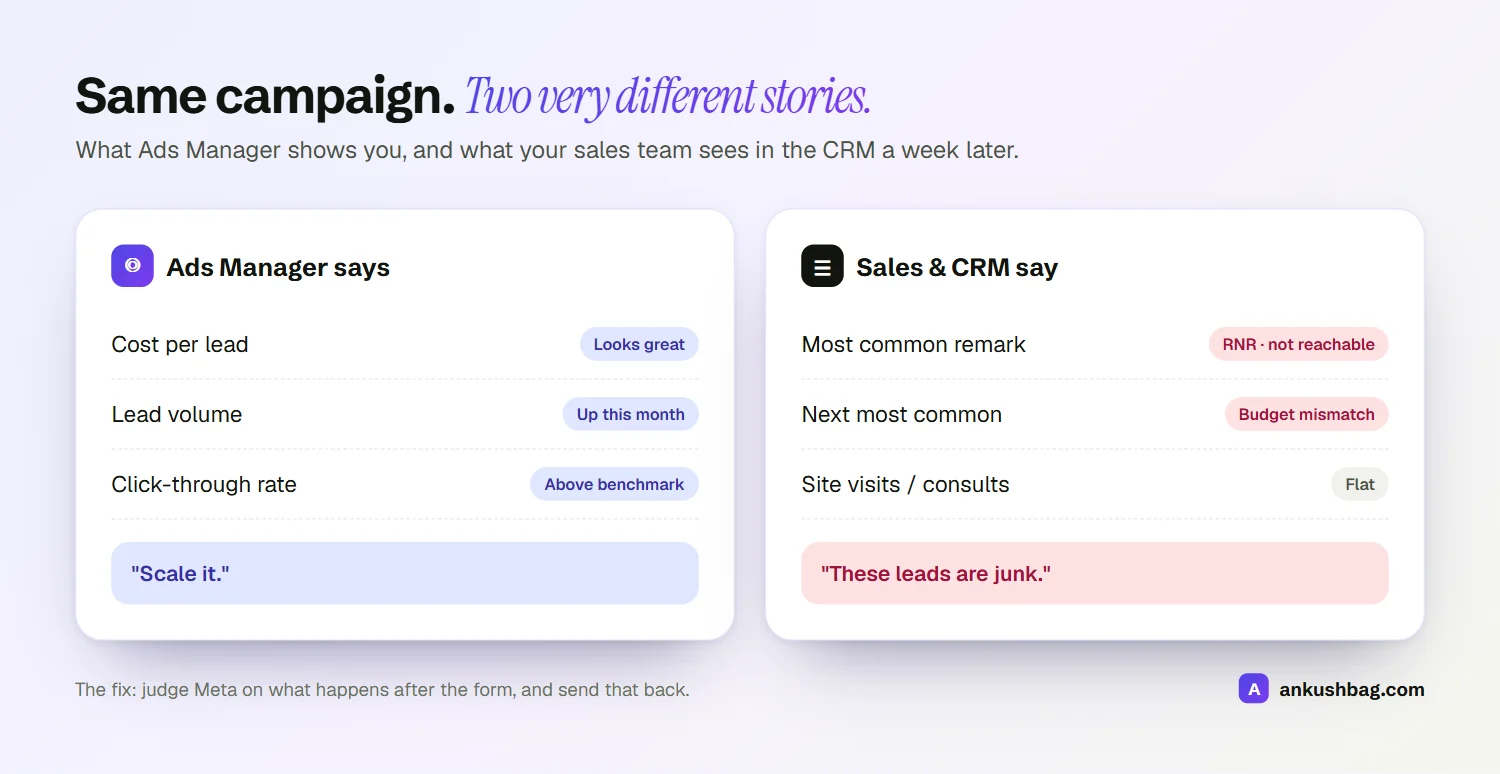
This is the one I see most. The CPL looks great, the agency is happy, and the sales team says the leads are junk. Low CPL often means Meta found people who fill forms easily, not people who buy. In real estate it shows up as leads marked RNR, budget mismatch or not interested, and those remarks never reach whoever runs the ads.
What good looks like
In one month I ran 2,500 leads, and 42% were marketing-qualified and 28% were sales-qualified. The goal was never the cheapest lead. It was leads sales actually wanted to call.
What Ads Manager shows, and what sales sees a week later.11The "hack"
Is there a trick or setting that unlocks scale?
No. There's no secret button.
Scaling Meta in 2026 is boring in the best way: a good offer, a steady flow of distinct creative, broad targeting, and honest data flowing back from sales. Anyone selling a "hack" is selling the next three months, not the next three years.
The companies that scale treat Meta as one part of the system, connected to what happens after the lead. That connection is the work I do.
Written from hands-on account work. Platform features change; this reflects how Meta ads behave as of 2026.
Meta ads review
Get a straight answer on your account.
Tell me where it hurts. I'll reply personally with the first things I'd check, across the ads and what happens to the leads after.
Where the budget leaks across the 11 points above
Lead quality vs CPL: what sales actually does with your Meta leads
What to fix first, ranked by likely impact
No retainer pitch. If Meta isn't your real problem, I'll say so.
Let's talk
Meta brings the lead. What happens next?
Most growth gets lost after the form: the call that came late, the remark that never reached marketing. Ask me to check your account, and I'll tell you straight where the budget is leaking.