Every extra charge, listed before you ask.
No 10-step routine. Just 3 things that work.
The scariest part of surgery is the night before.
A lead-gen ad has to bring people your sales team wants to call. A D2C ad has to make someone buy, and come back. Same platform, different brief.
If your cost per lead keeps creeping up, or your leads keep going cold, it's usually one of these. None of them gets fixed by a new colour.
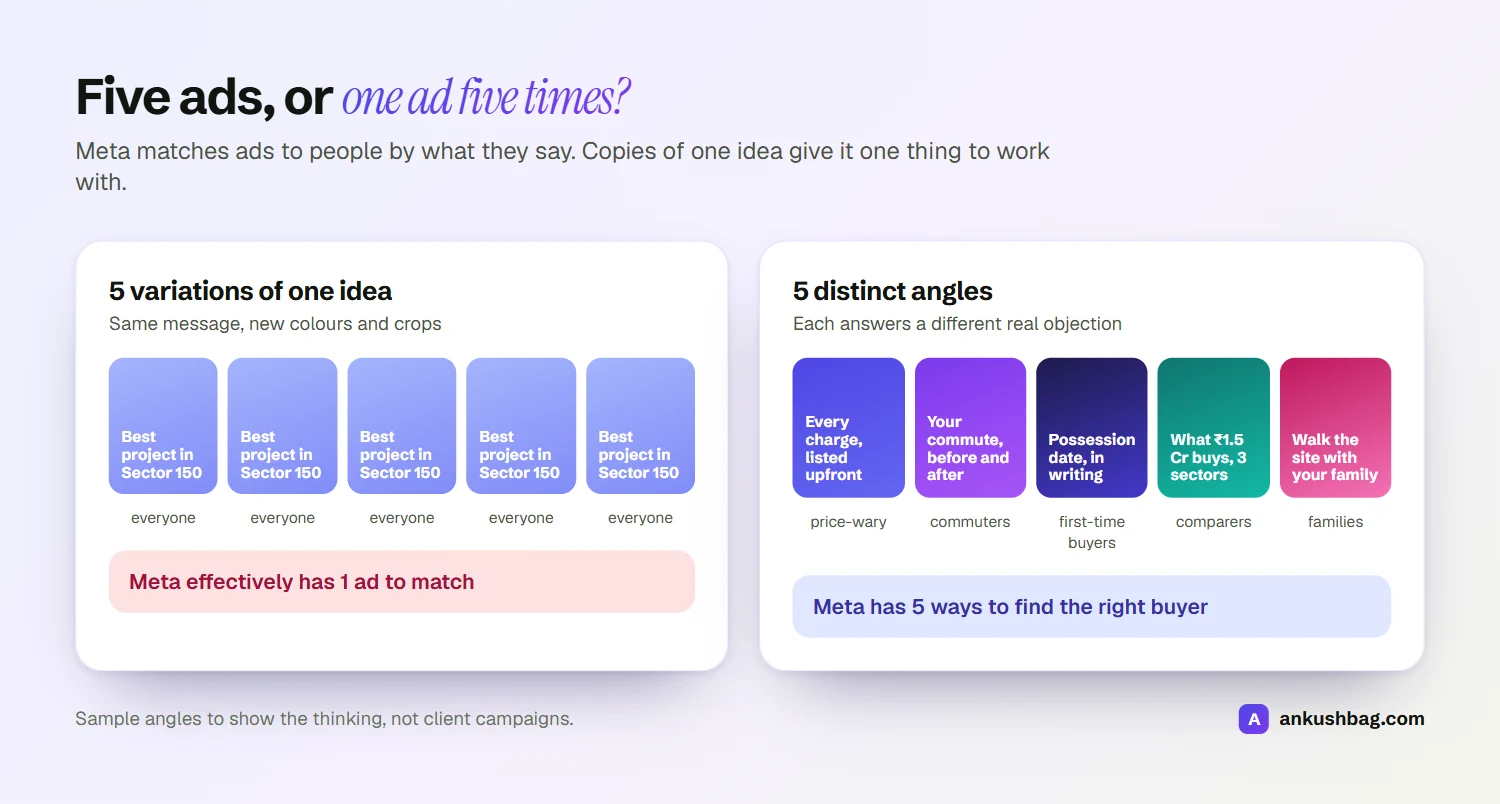
Colour, font and button swaps look like testing. To Meta they're one ad, so you pay to learn nothing.
Logo first, the point at second eight. People decide in the first three seconds whether an ad is for them.
"Best hospital in Gurugram" finds everyone and converts no one. A specific ad finds a specific buyer.
It worked, so nobody replaced it. Now it's tired, cost per lead or ROAS is sliding, and nothing new is ready.
The cheapest lead or click wins the budget, even when sales marks those leads junk or those buyers never order again.
Nobody tells the creative team which ads brought real buyers or repeat customers, so the next round repeats the last one.
Andromeda, the system Meta uses to pick which ad each person sees, can weigh far more ads than before. Give it five ads that say the same thing and it has one ad to work with. Give it five different angles and it can match each one to the people it fits.

A new offer and a swapped-in banner is a promotion. Meta is won by the creative system underneath it.
Two companies can spend the same on the same platform and get completely different leads. Usually it's the ad. When everyone in a category runs the same ad with a different logo, everyone gets the same people who aren't serious. My team and I use AI to make and test more ideas, faster, and we keep the call on which ones are worth scaling.
One idea with a point of view, built from a real customer insight, instead of 40 versions of the same ad. Better ideas bring people who are actually interested.
Product films, UGC-style video, statics and carousels produced with AI, so testing is limited by ideas, not by production budget.
Angle, hook and format tested in a clear matrix, and judged on qualified leads and customers, not click-through rate.
A few of the ways one product can show up in the feed
Research, ideas, production and testing as one job, so nothing gets lost between the brief and the result.
Sales calls, product reviews, returns and comment sections, to find the objections that actually stop people buying.
Openers written for the first three seconds, and scripts that answer one objection each.
Images and carousels that make one point clearly, sized for feed, stories and reels.
Product films, UGC-style video and explainers, made with AI so testing isn't capped by production budget.
Angles tested against each other in a clear matrix, so you learn which idea works, not which colour.
Every angle judged on qualified leads, or on purchases and repeat orders, and that feeds the next round of creative.
Short cycles beat big launches. Each round teaches the next one what your buyers respond to.
Sales calls, product reviews, comments and your past ads, to find the three to five objections that decide the sale.
Each objection becomes a distinct angle with its own hook, not a variation of the last ad.
Statics, carousels and video, made fast with AI. My team and I keep the judgment on what's worth running.
Judge each angle on qualified leads or purchases, scale the winners, retire the rest, and start the next round.
Pick an industry. Each card starts from one buyer objection and turns it into a hook.
Sample angles to show the thinking, not client campaigns. Healthcare angles are written within ASCI and medical-council advertising rules.
“In one month I ran 2,500 leads. 42% were marketing-qualified and 28% were sales-qualified. The goal was never the cheapest lead. It was leads sales actually wanted to call.”
What founders usually ask about creative work on Meta.
Fewer than you think, as long as they're different. A small set of distinct angles teaches Meta more than dozens of versions of one idea. The right number depends on your spend: enough for each angle to get a fair test, then a fresh round as the winners start to tire.
Yes. For D2C, each angle is built for the purchase: a reason to buy now that isn't just a discount, and a hook for the person most likely to reorder. It's judged on purchases, cost per order, ROAS and repeat orders. The offer gets as much thought as the ad. A starter kit often beats another 20% off.
Yes, for speed: drafts, variations, statics and video. The angle, the hook and the call on what's worth running stay human. AI makes testing cheaper. It doesn't decide what to say.
I can, or I can hand the creative to your in-house team or agency. Either way I'll want to see real results, qualified leads or purchases, not just click-through rate, because that's what shapes the next round.
Your past ads and their results, a few sales or presales call recordings or remarks, and your product details. The calls matter most. That's where the real objections are.
Yes. Specific doesn't mean making promises. Angles are written within ASCI and medical-council advertising rules: no guaranteed results, no misleading claims, clear information instead.
It depends on how much creative you need and in which formats. Start with the free angles. If it makes sense to keep going, you get a fixed scope and price. No retainer pitch on the first call.
Tell me what you sell and who buys it. I'll reply personally with three distinct angles worth testing on Meta.
No retainer pitch. If creative isn't your real problem, I'll say so.
Send me your product and your current ads. I'll show you three angles worth testing, and tell you straight what's holding the current ones back.